
Fire Risk
#saynotooldhayes

Whilst the risk of solar panel systems catching fire is extremely low, like any other technology that produces electricity, they can catch fire.
A greater risk is associated with Battery Energy Storage Systems (BESS)
If there were a fire in the BESS at Old Hayes Solar Farm it could potentially lead to contamination.
BESS fires can lead to various forms of contamination, including air pollution from toxic smoke and gases, soil contamination from fire suppression efforts, and water contamination from runoff.
A fire breaking out when land is flooded could make it difficult or impossible for the emergency services to access
Battery Energy Storage Systems (BESS) present significant fire safety hazards due to the nature of battery fires, their fast spread and toxicity. While there have been incidents of fires at BESS sites in the UK, there’s no publicly accessible record of the exact number. The most prominent incident occurred in Liverpool in September 2020, where a fire took 59 hours to extinguish after an explosion. Other incidents, like the one at Statera Energy’s Thurrock site in February 2025 and the one in East Tilbury, have also been reported. These fires highlight concerns about the fire safety of BESS, particularly related to lithium batteries and the potential for thermal runaway. (AI overview)
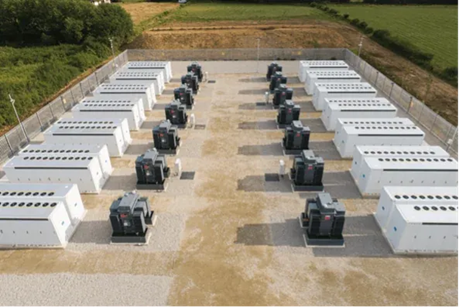
UK PARLIAMENT APRIL 2024, Battery Energy Storage Systems
https://researchbriefings.files.parliament.uk/documents/CBP-7621/CBP-7621.pdf
APRIL 4th 2025, A Fire at the Cirencester Hybrid Solar Farm
The recent fire at Cirencester Hybrid Solar Farm is a stark reminder of the risks tied to Battery Energy Storage Systems (BESS). As BESS plays a vital role in the clean energy transition, this incident highlights the urgent need for smarter, safer solutions—like immersion cooling—to prevent future disasters
https://eticaag.com/a-fire-at-the-cirencester-hybrid-solar-farm/
For a Commentary on Fire Risk and BESS from the Focus Group, November 2025 and a recent publication, click the link below. READ MORE…
Commentary on Fire Risk and BESS from Coleshill Solar Focus Group
A developer Ethical Power proposed a small solar farm in Hampshire (Glebe Farm Solar and Battery Energy Storage System, Winchester City Council Planning Application 25/01050/FUL) but they removed the BESS and associated infrastructure from the Application. They noted that this removed the requirement to consider safety matters associated with BESS fire risk. This raised issues relevant to ABEI’s Old Hayes proposal.
In Coleshill Parish Council’s submission to the Vale of the White Horse, BESS Fire Risk is flagged up, but not treated in detail due largely to the fact that ABEI do not cover this topic in any substantive way in their Application. There is no Fire Risk Assessment at this stage. There is brief reference to Fire in the Planning Design and Access Statement, paras 2.14 et seq, repeated in the Environmental Statement, Chapter 3. There are no measured drawings of the BESS compound layout (only a diagrammatic small-scale layout on plan MP2.1_PV OLH_Layout_Ed00).
Oxford CC’s Fire Safety response is basically an assumption that there will be data in due course.
Given the dangers of BESS fire, the National Fire Chief’s Council (NFCC) issued Guidance for Fire and Rescue Services in 2022, not updated but consistently referred to in more recent Health and Safety Guidance by the Dept for Energy Security and Net Zero in March 2024. The NFCC Guidance states that ‘a robust Emergency Response Plan should be developed’ – a ‘comprehensive risk management process undertaken to identify hazards and risks, and develop, implement and maintain risk controls’. The document outlines many topics which should be covered in the Plan. ABEI references this document, but has not produced the plan as yet.
Issues which ABEI would need to give include:
- Information on the battery chemistry, relevant to the propensity for thermal runway;
- Spacing and lay-out of the battery units; minimum distances between the containers;
- Provision of sufficient water for cooling in the case of fire (ABEI’s water tank is at the very minimum acceptable volumd limit);
- Fire Service access arrangements (space for 2 fire engines to pass);
- Disposal of contaminated water after fire (ABEI say it will be tankered off site – where to, and how, if there is more than the water tank’s capacity?);
- ‘Worst-case scenario’ should be planned for.
It is worth noting that the Inspector in a Pound Road, Hawkchurch (APP/U1105/W/22/3312300) case ruled that: “Given the scale of harm and the sensitivity of the surrounding area [to fire risk from BESS], fire safety must be treated as a determinative issue, not a matter capable of resolution post-consent.”
Solar Farms tab, ctd
For a recent publication on this issue, a document clearly outlining the fire risks associated with BESS has been written by Oxford and Kent University scientists, dated February 2025.
Crime on Solar Farms
#saynotooldhayes
Risk of crime on Solar Farms has increased. They are targeted principally for the copper used in the cables. In remote locations emergency response times are frequently slow. Once a site has been targeted it is statistically at increased risk of being targeted again.
This is the response, dated 29 January 2024 from the Crime Prevention Officer, Kevin Cox, to the Scoping Opinion Request submitted to Vale of White Horse:
- According to national data reported so far, reported crimes on solar farms has increased by 93% comparing 2021 to 2022. This is driven by a 48% increase in thefts of cables, and thefts of solar panels has quadrupled, comparing 2021 to 2022.
- Cables on solar farms are usually copper, and are stolen for their scrap value.
- Solar panels are usually stolen for their resale value.
- Historically, it has mainly been Organised Crime Gangs that would target solar farms, travelling the length of the country. However, in the last year, it is thought that around 25% of the reported offences on solar farms are due to local offenders who repeatedly target the same areas.
- There continues to be a high level of repeat victimisation; once a solar farm has been targeted once, it is likely to be targeted again. 61% of solar farms that reported a crime in 2022 either suffered another offence in the same year, or a solar farm within 5 miles did.
- The price of copper is forecast to increase in to 2024. This will drive up the rate of cable theft across all industries, including solar.
- Rural crime is increasing—the cost of rural crime in the UK rose over 40% in the first quarter of 2022.
- The proposal for this installation is a 2m high stock proof boundary treatment which will provide little deterrence value at all.
- Thames Valley Police have considered the issue of security of Solar Farms, most of which are sited in rural areas and can perhaps expect at best a response taking up to 15‐20 minutes and have formulated an appropriate recommendation based on that expectation.
- Security fencing, rather than post and rail is the minimum requirement for a Solar Farm. The purpose of security fencing is to Deter, Delay and Detect. LPS 1175 Issue 8 Security fencing is tested to withstand attack over certain periods of time against a progressive and more inclusive array of tools.
Several websites highlight the increased risk of crime:
https://securityjournaluk.com/a-spotlight-on-intrusion-in-solar/
https://detertech.com/critical-infrastructure-security…
https://static.aviva.io/solar-farm-security
The message is that crime is on the increase and that remote locations are more at risk. Residents who live in isolated properties close to the site feel vulnerable.
Whilst improved security systems and higher security fencing can help to protect the site, they also add to the highly intrusive nature of the visual impact.
Risks

Solar Farms
